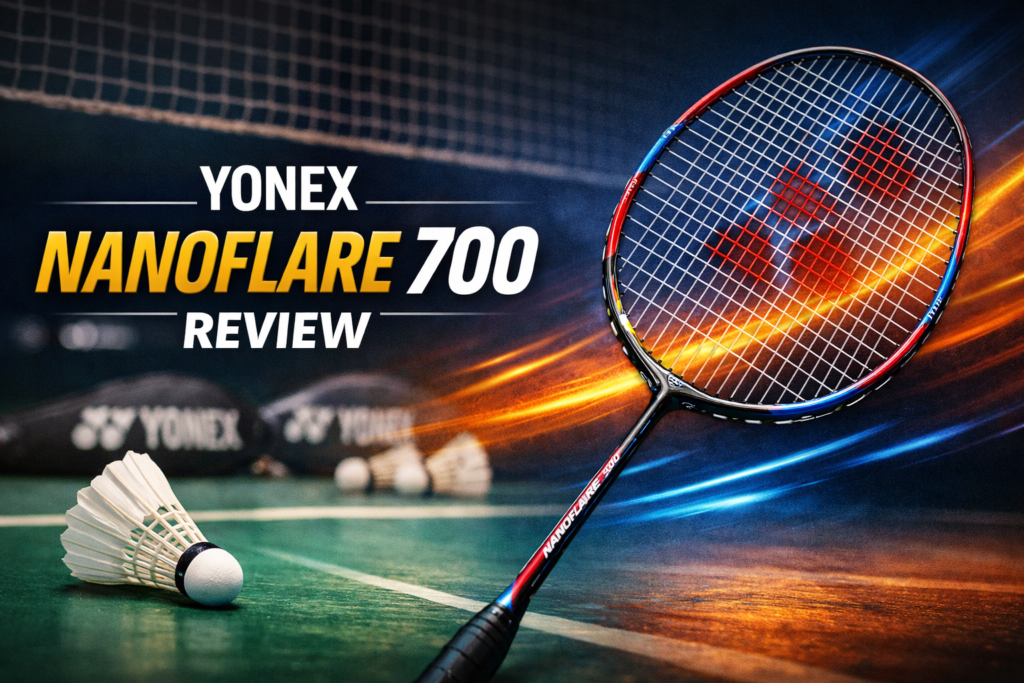
Yonex Nanoflare 700 Review – A Story of Speed, Control, and Unexpected Lessons
I still remember the first time I picked up the Yonex Nanoflare 700. It wasn’t one of those dramatic, cinematic moments where everything slows down and you instantly know you’ve found “the one.” In fact, it was the opposite. It looked… modest. Clean, minimal, almost understated compared to some of the flashier rackets hanging beside it.
But sometimes, the quiet ones have the most to say.
This review isn’t just about specs, performance charts, or technical jargon. It’s about what it feels like to live with this racket—through long rallies, frustrating losses, surprising wins, and those small moments on court where everything just clicks.
First Impressions: Light, But Not Weak
When I first held the Nanoflare 700, the immediate thing I noticed was how light it felt. If you’re used to head-heavy rackets, this one might almost trick you into thinking it lacks power. The frame is slim, aerodynamic, and clearly designed with speed in mind.
But here’s the thing—light doesn’t mean fragile, and it definitely doesn’t mean powerless.
There’s a certain confidence that builds when you swing it for the first few times. The balance is head-light, yes, but it’s not hollow or empty. Instead, it feels responsive, almost like the racket is anticipating your movement before you fully commit to it.
And that’s when it started to make sense: this racket isn’t trying to overpower your opponent. It’s trying to outsmart them.
The First Game: Adjusting Expectations
I’ll be honest—the first game with the Nanoflare 700 was… rough.
My clears were fine, but my smashes? They felt weaker than usual. I kept expecting that heavy punch you get from head-heavy rackets like the Astrox series, but it just wasn’t there. For a moment, I wondered if I had made the wrong choice.
But then something interesting happened.
As the game went on, I started reacting faster. My defense improved almost without me realizing it. Drives became sharper, quicker. Net play felt more precise. It was like switching from a heavy hammer to a finely balanced blade—you lose brute force, but gain control and speed.
And that’s when the personality of the Nanoflare 700 began to reveal itself.
Speed: Where This Racket Truly Shines
If there’s one word that defines the Nanoflare 700, it’s speed.
Not just swing speed, but reaction speed. In fast-paced doubles rallies, where the shuttle moves like a blur, this racket feels like an extension of your hand. There’s no lag, no hesitation. You think, you move, and the racket is already there.
Defensive shots—blocks, lifts, quick drives—become significantly easier. I found myself returning smashes that I would normally struggle with, simply because I could position the racket faster.
It almost feels unfair at times.
And in doubles, that’s a huge advantage. The faster you can react, the more pressure you can absorb—and eventually turn back on your opponent.
Control: Subtle but Powerful
Control is one of those things that doesn’t always stand out immediately. It’s not flashy. It doesn’t get applause. But over time, you realize how much it shapes your game.
With the Nanoflare 700, control comes in a very natural way. The shuttle goes where you intend it to go, without needing excessive correction. Drops feel tighter. Net shots feel softer and more precise.
There’s a kind of quiet confidence that builds when you know your racket will respond accurately.
And this matters more than people think.
Because in badminton, it’s not always the strongest smash that wins the point—it’s often the well-placed shot that forces your opponent into a mistake.
Power: The Trade-Off
Let’s address the obvious question: Does the Nanoflare 700 lack power?
The honest answer is—it depends on what you expect.
If you’re coming from a head-heavy racket and you rely heavily on smashing to win points, then yes, you will feel a drop in raw power. There’s no way around that.
But here’s the nuance: the power isn’t gone—it’s just different.
Instead of relying on weight, the Nanoflare 700 relies on speed and technique. If your timing is good and your swing is sharp, you can still generate solid smashes. They might not be as heavy, but they’re faster and often harder to read.
Over time, I found myself smashing less—but winning more points.
Why?
Because I was setting up my attacks better, using placement and variation instead of brute force.
It’s a subtle shift, but a meaningful one.
Defense: A Game-Changer
This is where the Nanoflare 700 truly changed my perspective on badminton.
Before using it, I used to think of defense as something reactive—a way to survive until you could attack again. But with this racket, defense became… proactive.
Returning smashes felt easier, yes. But more importantly, it felt controlled. I wasn’t just lifting the shuttle back—I was directing it, placing it, turning defense into opportunity.
In doubles, this is huge.
A good defensive return can immediately put your opponents under pressure, especially if you can redirect the shuttle quickly and accurately. The Nanoflare 700 makes this not only possible, but almost instinctive.
And once you experience that, it’s hard to go back.
Build and Technology: More Than Marketing?
Yonex markets the Nanoflare 700 with technologies like the Sonic Flare System and the use of high modulus graphite.
At first glance, these sound like typical marketing buzzwords. But in practice, you can actually feel the difference.
The frame feels stable despite its lightness. There’s a crispness to the contact that gives you feedback without being harsh. It’s not overly stiff, which makes it more forgiving, especially for intermediate players.
And durability? So far, it holds up well. No unexpected vibrations, no signs of weakness even after intense sessions.
It’s clear that this racket wasn’t just designed to be light—it was designed to be reliably light.
Singles vs Doubles: Where Does It Fit?
If you’re wondering whether the Nanoflare 700 is better for singles or doubles, the answer leans strongly toward doubles.
In doubles, speed is everything. Quick exchanges, fast reactions, rapid transitions between attack and defense—this is where the Nanoflare 700 thrives.
In singles, it’s still usable, but you might feel the lack of power during long rallies and when trying to finish points with strong smashes. That said, if your playing style focuses on placement, control, and endurance, it can still perform well.
But if you’re a power-heavy singles player, you might want to look elsewhere.
Who Is This Racket For?
The Nanoflare 700 isn’t for everyone—and that’s actually a good thing.
It’s ideal for:
- Players who value speed and quick reactions
- Doubles players who need strong defense and fast drives
- Intermediate to advanced players looking to refine control
- Players who prefer a lighter, more maneuverable racket
It might not be the best choice for:
- Beginners who rely heavily on power
- Players who prefer head-heavy rackets
- Smash-focused attackers who want maximum force
Choosing a racket is a bit like choosing a partner on court—it has to complement your style, not fight against it.
The Unexpected Lesson
Using the Nanoflare 700 taught me something I didn’t expect.
It taught me to slow down—not physically, but mentally.
Instead of rushing for the winning smash, I started thinking more about setup, positioning, and timing. I became more patient, more aware of the flow of the game.
And strangely enough, that made me faster.
Because speed in badminton isn’t just about how quickly you move—it’s about how efficiently you think and react.
The Nanoflare 700 doesn’t just change your shots. It changes how you approach the game.
Final Thoughts: Quietly Impressive
The Yonex Nanoflare 700 isn’t the kind of racket that screams for attention. It doesn’t promise overwhelming power or instant dominance.
Instead, it offers something more subtle—and arguably more valuable.
It offers speed, control, and a chance to play smarter.
It’s the kind of racket that grows on you. The more you use it, the more you understand it. And the more you understand it, the more it rewards you.
So if you’re looking for a racket that helps you hit harder, this might not be it.
But if you’re looking for a racket that helps you play better—this one is definitely worth your time.
And sometimes, that makes all the difference.