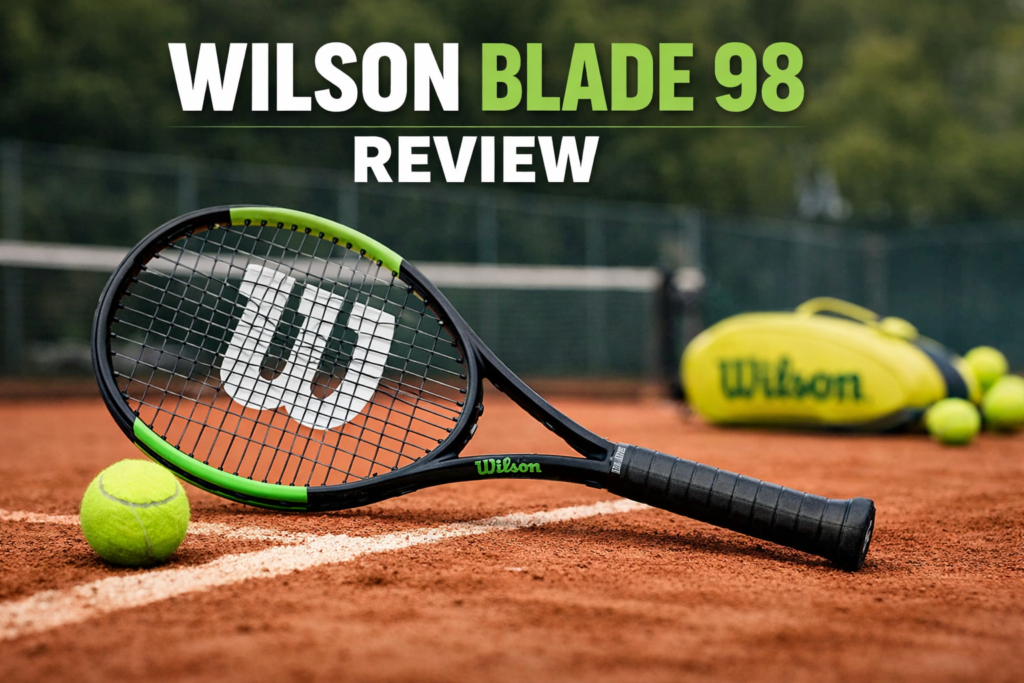
When I first picked up the Wilson Blade 98, it didn’t feel like just another tennis racket—it felt like a conversation waiting to happen.
I remember standing on the baseline, bouncing the ball a few times, not entirely sure what to expect. I had heard the reputation: precision, control, a racket designed for players who like to dictate points rather than react to them. But hearing about a racket and actually playing with it are two completely different things. The Blade 98, as I quickly learned, isn’t something you fully understand in the first five minutes. It reveals itself slowly, almost deliberately, like it’s testing whether you’re paying attention.
The first rally felt… quiet. Not in sound, but in sensation. There was no overwhelming power jumping off the strings, no explosive trampoline effect. Instead, there was this muted, controlled response—as if the racket was saying, “You decide what happens next.” For some players, that might feel underwhelming at first. For me, it felt intriguing.
As the rally extended, something started to click.
The Blade 98 doesn’t give you easy power, but what it gives instead is something far more addictive: trust. Each time I swung through the ball, I began to notice how predictable the response was. The ball went exactly where my swing path told it to go. Not more, not less. There’s a kind of honesty in that, and once you tune into it, it changes the way you play.
I started taking fuller cuts at the ball. Normally, with more powerful rackets, there’s always that slight hesitation—you subconsciously hold back, afraid the ball might fly long. But with the Blade 98, that fear fades. You swing faster, commit more, and in doing so, you discover a different rhythm to your game.
And that’s when the magic begins.
One of the standout characteristics of the Blade 98 is its feel. Wilson’s focus on “feel” isn’t just marketing language—it’s something you actually experience with every shot. The feedback is crisp but not harsh, connected but not overly raw. When you hit the sweet spot, there’s this clean, almost satisfying “pocketing” sensation, as if the ball lingers on the strings just long enough for you to guide it.
It reminded me of those moments when everything aligns perfectly in a match—the timing, the footwork, the confidence. The racket doesn’t create those moments, but it amplifies them. It makes you more aware of your own technique, your own decisions.
Of course, that also means it doesn’t hide your mistakes.
If your timing is off, you’ll feel it. If your footwork is lazy, the shot won’t magically land in. The Blade 98 is not forgiving in the way beginner-friendly rackets are. It demands attention. It demands intention. But in return, it offers a level of control that feels almost personal.
I found this especially noticeable on my backhand.
There’s something about the Blade 98 that makes backhands feel incredibly stable. Whether it’s a one-hander slicing low over the net or a two-handed drive down the line, the racket feels solid, grounded. The ball stays on the strings just long enough for you to shape the shot, and the directional control is exceptional.
During one particular practice set, I remember hitting a backhand down the line that felt almost effortless. Not powerful, not flashy—just precise. The kind of shot that doesn’t draw applause but quietly wins you the point. That’s the Blade 98 in a nutshell: it’s not about spectacle; it’s about execution.
At the net, the story continues.
Volleys with the Blade 98 feel controlled and deliberate. There’s no excessive pop, but there’s a reassuring stability that makes placement easy. You don’t feel rushed, even when the ball comes at you quickly. Instead, you feel like you have time—just a fraction of a second more—to make the right decision.
Drop volleys, in particular, become a joy. The touch is there, the sensitivity is there, and when you execute it well, the racket rewards you with a soft, controlled response that dies just over the net.
Serving, however, is where your relationship with the Blade 98 really gets tested.
If you’re used to rackets that give you free power on serves, the Blade 98 might feel demanding at first. You have to generate your own pace. Your technique matters more. Your timing matters more. But once you adjust, the payoff is undeniable.
Placement becomes your biggest weapon.
I found myself aiming for smaller targets—out wide, down the T, into the body—and actually hitting them more consistently. The control on serves allows you to be more strategic, more intentional. Instead of just trying to hit the ball hard, you start thinking about how to construct the point from the very first shot.
And that’s really what the Blade 98 encourages overall: thoughtful tennis.
It’s not a racket that encourages reckless hitting or lazy play. It invites you to engage with the game on a deeper level. Every shot becomes a choice, and every choice has a clear outcome. There’s a certain satisfaction in that clarity.
But let’s be honest—this racket isn’t for everyone.
If you’re a beginner or someone who relies heavily on the racket for power, the Blade 98 might feel too demanding. It doesn’t give you easy depth. It doesn’t compensate for poor technique. In fact, it might expose those weaknesses more clearly than you’d like.
However, for intermediate to advanced players—especially those who value control, feel, and precision—the Blade 98 can be incredibly rewarding.
It’s the kind of racket that grows with you.
The more you improve your technique, the more the racket gives back. It doesn’t limit you; it expands with you. And that’s a rare quality. Many rackets feel great at a certain level but become limiting as your game evolves. The Blade 98, on the other hand, feels like it’s always keeping up, always ready for more.
Another aspect worth mentioning is comfort.
Despite its control-oriented design, the Blade 98 is surprisingly comfortable on the arm. The feel is connected without being harsh, which is important for players who spend long hours on the court. You don’t walk away feeling battered. Instead, you feel like you’ve been in a dialogue—with the racket, with the ball, with your own game.
Over time, I started to notice something subtle but important: my style of play was changing.
I was becoming more patient, more deliberate. Instead of going for low-percentage winners, I was constructing points more carefully. Moving my opponent, waiting for the right opportunity, and then executing with precision. The Blade 98 didn’t force this change, but it encouraged it.
It made me a smarter player.
And maybe that’s the real strength of this racket. It doesn’t just improve your shots—it influences your mindset.
There’s a certain honesty to it. It doesn’t promise easy results or instant improvement. Instead, it offers a partnership. It says, “If you put in the work, I’ll meet you there.”
By the end of my time with the Blade 98, I realized that reviewing it wasn’t just about listing specs or performance categories. It was about describing an experience—one that unfolds gradually, one that challenges you, and ultimately, one that rewards you.
So if you’re considering the Wilson Blade 98, ask yourself this: what kind of player do you want to be?
If you want something that does the work for you, this might not be the right choice. But if you’re willing to take responsibility for your game, to refine your technique, and to embrace a more intentional style of play, then the Blade 98 might be exactly what you’re looking for.
It’s not just a racket.
It’s a conversation.
And if you’re willing to listen, it has a lot to say.